
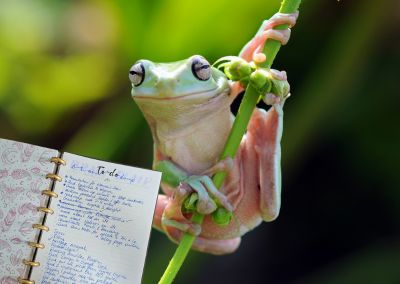
If you’ve ever stared at your to-do list and felt stuck, you’re not alone. Productivity isn’t only about doing more. It’s about doing what matters. That is the idea behind the Eat the Frog technique.
It’s a simple method for starting the day with the one task that counts. Here is what it means, why it helps, and how to fit it into your planning.
What is the Eat the Frog technique?
The technique was popularized by author Brian Tracy in his book Eat That Frog! The phrase comes from a line often attributed to Mark Twain:
“If it’s your job to eat a frog, it’s best to do it first thing in the morning.”
Your “frog” is your most important task, the one that moves your work or your life forward. It’s also usually the one you’re most likely to avoid.
Eating the frog means doing that task first, before email, social media or other distractions take over your morning.
Why it works
The method is simple, and that is its strength. When you start the day with what matters most, a few good things tend to follow:
- Fewer decisions. Choosing from a long to-do list is tiring. If you’ve picked your frog in advance, there’s nothing to decide.
- Early progress. Finishing something difficult first gives you a quick win to carry through the day.
- Less avoidance. A task you keep putting off hangs over everything else. Doing it early clears the space.
- More room later. When the important work is done, your afternoon and evening are free for flexibility, rest or time with people you care about.
How to find your frog
Not every task deserves frog status. Look for the one thing that will make the biggest difference today. Ask yourself:
- What one task would make me feel I’d done something real if I finished it today?
- What have I been avoiding that really needs to get done?
- Which task moves me closest to my goals?
Your frog might be a client deliverable, a hard conversation, or the financial paperwork you’ve been putting off. If it feels important and a little uncomfortable, it’s probably a frog.
How to use it in your planning
This works well with a paper planner, especially one with room for a weekly view. Here is a simple routine:
- Choose your frogs when you plan the week. Look at your bigger goals and pick one to three priorities. Write them clearly in your planner.
- Schedule it first. Block time for your frog early in the day, before other tasks creep in. Treat that time like a meeting with your most important client.
- One frog a day. Don’t try to swallow the whole swamp. If you have several, start with the one that has been weighing on you most.
- Mark it done. Take a moment when you finish. A walk, a good coffee or a firm checkmark is enough.
Common mistakes
- A vague frog. “Work on website” is unclear. “Write the homepage draft” is something you can start.
- A frog that isn’t high-impact. Clearing your inbox may feel good, but it’s rarely a frog unless it clears the way for something important.
- Deciding in the morning. If you wait until the day starts to choose, you’ll likely choose something easier. Pick your frog the night before or during your weekly review.
A small place to start
Planning should bring clarity, not more pressure. If you’re feeling scattered or behind, choose tomorrow’s frog right now. Write it down, set aside time for it, and protect that time.
Eat the Frog isn’t about hustling harder. It’s about putting your best energy where it counts, before the day pulls it somewhere else. If you’d like to pair it with a longer view of your week, time blocking is a natural next step.