


Introduction
I remember walking out of my supervisor’s office, expecting to feel clearer about my next steps. Instead, I felt paralyzed. My to-do list had doubled, my deadlines were close, and I had no idea where to start.
That moment taught me something: being busy isn’t the same as being productive. I was handling a lot of tasks but had no real plan for my time.
So I built a simple, repeatable system. This Quick-Start Guide to Planning helps you:
- Decide what matters most
- See your week at a glance
- Leave room for rest and personal time
If an endless to-do list has ever left you stuck, this guide is for you. No fancy tools and no complicated set-up, just a practical way to plan your week.
Why Planning Often Feels Hard
If your planning system feels like a chore, you’re not alone. A few common pitfalls:
- Overloaded to-do lists: writing down every task without deciding what is important.
- Reacting instead of planning: putting out fires instead of working toward longer-term goals.
- Underestimating time: trying to fit 12 hours of work into an 8-hour day.
- Skipping personal time: leaving no room for rest or creativity.
Without a clear system, it’s easy to stay busy without making real progress. A simple routine helps you feel less scattered and more in control of your time.
The Four Steps
The Quick-Start Guide simplifies planning into four steps.
Step 1: Brain Dump Everything on Your Mind
Before you can set priorities, clear the mental clutter. A brain dump gets everything out of your head and onto paper.
- Without filtering, write down everything: tasks, ideas, deadlines, errands, worries.
- Don’t organize yet. The goal is to free up mental space so you can focus.
- Once it’s all laid out, you can see what truly matters.
This is the foundation of the system, because it gives you clarity before you start building a schedule.
Step 2: Sort Using the Eisenhower Matrix
Now sort your brain dump with the Eisenhower Matrix:
- Urgent and important: needs action now (deadlines, crises).
- Important but not urgent: supports your longer-term goals (planning, learning).
- Urgent but not important: feels pressing but doesn’t move your work forward (many emails, interruptions).
- Not urgent and not important: distractions you can drop or put off.
Sorting this way helps you see what actually deserves your attention, rather than defaulting to whatever feels urgent.
Step 3: Plan Your Week
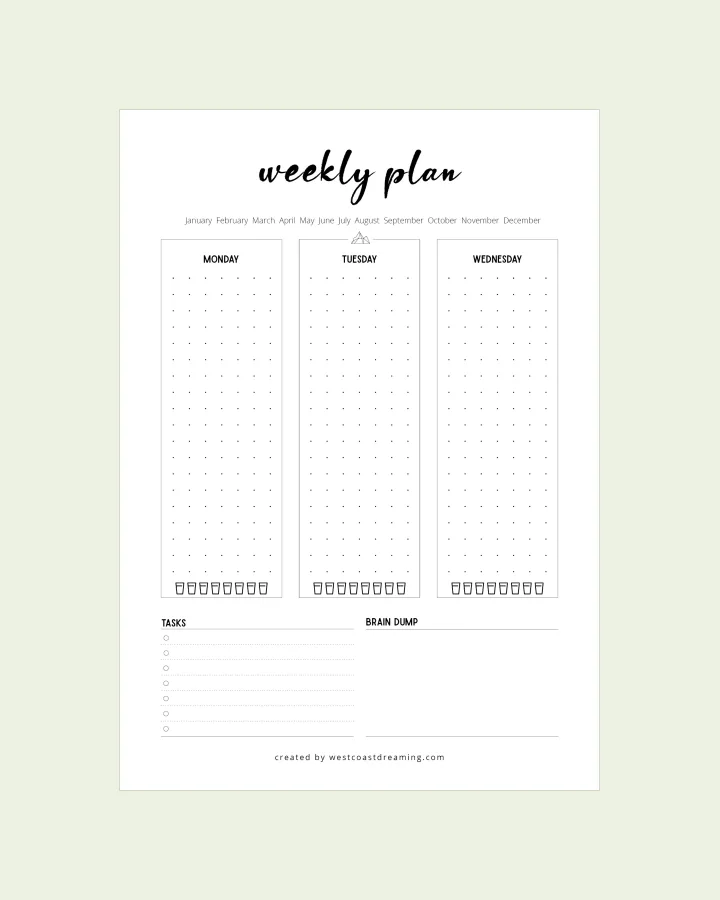
Turn the sorted list into a plan. Focus on four groups:
- Top 3 priorities: the three most important tasks for the week.
- Tasks to schedule for later: important but not urgent, and they need a date.
- Tasks to delegate or automate: anything that doesn’t need you.
- Tasks to let go of: things that don’t serve your goals.
Tip: use time blocking to set aside focused time for your priorities, and protect those blocks as you would an important meeting. There’s more on that in the time blocking post.
Step 4: Reflect and Reset
At the end of the week, take a few minutes to ask:
- What worked well?
- What didn’t go as planned?
- What will I change next week?
A short weekly review lets you improve the system over time, so it stays flexible and keeps you on track.
Starting on Paper
You don’t need special tools to begin. A notebook, a few loose sheets or a paper planner will do, because the system is the four steps, not the page. If you like a planner you can rearrange, our undated, disc-bound A5 planners are made for this kind of weekly routine. Whatever you choose, use it for two weeks before you change it.
Making It a Habit
Consistency matters more than the perfect system. Three simple ways to keep it going:
- Set a weekly planning time. Pick a regular slot, such as Sunday evening or Monday morning, to review your schedule, set priorities and map out your tasks.
- Review and adjust. At the end of each day or week, note what worked and what didn’t. Did you take on too much? Did something take longer than expected? Adjust.
- Keep it simple. The best planning system is the one you’ll use. Stick to a method that feels natural and sustainable.
Conclusion
Planning doesn’t have to be stressful or time-consuming. The Quick-Start Guide gives you enough structure to focus on what matters, without the overwhelm. Start with a brain dump today, and see how the week looks tomorrow.